




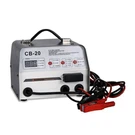

Hey there! As a supplier of 6V/12V/24V Battery Chargers, I often get asked about the recommended charging time for a 6V battery using a 6V battery charger. It's a common question, and the answer isn't as straightforward as you might think. There are a bunch of factors that come into play, and in this blog, I'm gonna break it all down for you.
First off, let's talk about the basics. A 6V battery charger is designed to charge a 6V battery, but the charging time can vary depending on the battery's capacity, the charger's output current, and the state of the battery when you start charging.
Battery Capacity
The capacity of a battery is measured in ampere - hours (Ah). It basically tells you how much charge the battery can hold. For example, a 6V battery with a capacity of 4Ah can supply a current of 4 amps for 1 hour, or 1 amp for 4 hours. The higher the battery capacity, the longer it will take to charge.
If you've got a small 6V battery, like the ones used in some kids' toys or small electronic devices, it might have a capacity of around 1 - 2Ah. On the other hand, larger 6V batteries, such as those used in golf carts or some industrial applications, can have capacities of 100Ah or more.
Charger Output Current
The output current of the charger is another crucial factor. Chargers come with different output currents, and this determines how fast they can add charge to the battery. A charger with a higher output current will charge the battery faster than one with a lower output current.
For instance, if you have a 6V battery charger with an output current of 1 amp, and you're charging a 6V, 4Ah battery, it would theoretically take about 4 hours to fully charge the battery (assuming the battery is completely discharged). But in reality, it usually takes a bit longer because charging isn't 100% efficient.
Most 6V battery chargers have output currents ranging from 0.5 amps to 10 amps or more. The charger you choose should be compatible with the battery you're charging. Using a charger with too high an output current can damage the battery, while a charger with too low an output current will take forever to charge the battery.
State of the Battery
The state of the battery when you start charging also matters. If the battery is only partially discharged, it will take less time to charge compared to a completely discharged battery.
Batteries can self - discharge over time, even when they're not in use. So, if you've had a 6V battery sitting on the shelf for a while, it might have lost some of its charge. Before you start charging, it's a good idea to check the battery's voltage with a voltmeter. A fully charged 6V battery should have a voltage of around 6.3 - 6.4 volts. If the voltage is significantly lower, the battery is discharged and will need to be charged.
Calculating the Charging Time
To get a rough estimate of the charging time, you can use the following formula:
Charging time (hours)= Battery capacity (Ah)/Charger output current (A) x 1.2
The factor of 1.2 takes into account the inefficiencies in the charging process. For example, if you have a 6V, 10Ah battery and a 6V battery charger with an output current of 2 amps, the estimated charging time would be:
Charging time = 10Ah / 2A x 1.2 = 6 hours
Keep in mind that this is just an estimate. The actual charging time can be affected by things like the battery's age, temperature, and the quality of the charger.
Temperature and Charging
Temperature plays a big role in battery charging. Batteries charge best at room temperature (around 20 - 25°C or 68 - 77°F). If the temperature is too low, the chemical reactions inside the battery slow down, and it will take longer to charge. On the other hand, if the temperature is too high, it can cause the battery to overheat, which can damage the battery and reduce its lifespan.
When charging a 6V battery, try to do it in a well - ventilated area at a moderate temperature. If it's really cold outside, you might want to bring the battery indoors to charge it.


Our Chargers
As a supplier of 6V/12V/24V Battery Chargers, we offer a wide range of chargers to suit different needs. Our Digital Universal Battery Charger is a great option if you need a charger that can handle multiple battery types and voltages. It has advanced features like automatic voltage detection and over - charge protection, which helps to keep your batteries safe and charged properly.
We also have Industrial Charger and Starter options for those heavy - duty applications. These chargers are built to last and can handle large - capacity batteries with ease.
Contact Us for Purchasing
If you're in the market for a 6V battery charger or any of our other charger products, we'd love to hear from you. Whether you're a hobbyist looking to charge a small 6V battery or an industrial user with big - scale charging needs, we've got the right charger for you. Just reach out to us, and we can discuss your requirements and help you find the perfect charger.
References
- Battery University: A great resource for all things related to batteries and charging.
- Manufacturer's specifications for batteries and chargers, which provide detailed information on charging requirements.