

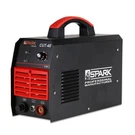


If you’ve ever stared at a dented metal garden gate, a rusted bike frame, or a sheet of steel leftover from a home renovation, and thought “I wish I could fix that myself,” you’ve probably stumbled across MMA welding—one of the most accessible (and intimidating) entry points into metalwork. As a supplier of Economic MMA Welding Machines that skip the heavy, expensive ammeter, I get asked this question at least twice a week: Can a total novice really use one of these machines without an ammeter?
Let’s start by demystifying two pieces of lingo that often scare new welders: MMA and ammeter. MMA, or Manual Metal Arc welding, is the process that uses a consumable, flux-coated electrode to create an arc between the metal you’re welding and the machine. That arc melts both the electrode (to form the weld metal) and the base metal, fusing them together as they cool. For decades, standard MMA machines included a bulky, analog ammeter—basically a dial that shows how much electrical current is flowing through the machine. Ammeters were once seen as non-negotiable: welders relied on them to adjust current, because if you set the current too low, the electrode wouldn’t melt properly (leaving a weak, uneven weld); too high, and you’d burn through the metal, splatter everywhere, or even get shocked.
But here’s the thing: ammeters were designed for professional welders, not hobbyists or first-timers. Back when welding machines were big, noisy, and analog, you needed that dial to make precise adjustments. Today, with advances in welding technology, we’ve reimagined Economic MMA Welding Machines to eliminate the need for an ammeter entirely—and make them usable for novices without sacrificing safety or quality.


Let’s talk about how that works. Modern Economic MMA machines don’t rely on analog parts to control current; instead, they use digital technology to regulate power accurately. That’s where our Digital MMA New Technology comes in: we’ve integrated pre-set, job-specific current levels into every machine, tested by professional welders to work for common materials and projects. For example, if you’re welding thin 1mm stainless steel for a small repair, the machine’s digital system automatically adjusts the current to a low, steady setting that won’t burn through. If you’re welding thicker 6mm steel for a gate or fence, it ramps up to the exact current needed without you having to tweak a dial. This isn’t “cutting corners” on functionality—it’s designing for the user, not just the tech.
I remember when we first tested this concept with a group of total novices at a local community workshop two years ago. We brought our Inverter Welder MMA-250 (one of our most popular Economic MMA models, no ammeter) and a handful of people who’d never held a welding torch before. One attendee, a retired teacher named Mary, wanted to fix the leg of her porch swing, which had rusted through. She’d never picked up a welding tool in her life, and she admitted she was scared of “blowing something up” or getting hurt. We walked her through the basics: how to clamp the metal pieces together, how to touch the electrode to the metal to start the arc, and how to move the torch in a slow, steady line. We didn’t show her an ammeter (since the machine doesn’t have one) — we just told her: “For this 3mm steel, set the machine to the ‘thin metal’ preset, and go slow.” By the end of the two-hour workshop, Mary had a smooth, solid weld on her porch swing. It wasn’t a showstopping professional weld, but it was strong enough to hold her weight when she tested the swing that same day. That moment made me realize: the ammeter was never the barrier—it was the fear of using the ammeter that was.
Now, let’s address the elephant in the room: “What if I’m not using a pre-set job? What if I need to adjust the current for a custom project?” For novices, 90% of welding projects fall into the common, pre-tested categories we’ve built into our machines. That’s the beauty of our Digital Inverter Welding Machine line: the digital control system measures the resistance of the metal in real time and adjusts the current automatically, so even if you’re working with a slightly different thickness than a preset, the machine handles the fine-tuning. Professional welders will sometimes adjust current manually for super-specific jobs, but for the average person fixing a bike, repairing a fence, or building a small metal shelf, that level of precision isn’t necessary. Our machines are built for Economic MMA use, which means they’re focused on what most people actually need—not the 1% of ultra-precise industrial jobs.
Safety is another big concern for novices, and removing the ammeter doesn’t compromise safety at all—if anything, it improves it. Analog ammeters are made of moving parts that can break, and they sometimes give inaccurate readings, leading welders to set the current wrong and cause accidents (like excessive splatter that can burn skin, or unsteady arcs that can produce harmful fumes). Our digital systems are calibrated to avoid that: they prevent current spikes, which means no sudden surges that could start a fire or damage the machine. Also, all our Economic MMA Welding Machines are designed with overheat protection, so if you hold the torch in one spot too long, the machine automatically lowers the current to avoid burning through metal. We tested these safety features in collaboration with professional welders, and they work just as well as the safety systems on our Professional MMA Welding Machine line—all for a fraction of the cost.
Wait, but what about metal type? Can I use an ammeter-less Economic MMA machine on stainless steel, aluminum, or cast iron? The short answer is yes—with the right electrode, of course. We sell a dedicated Stainless Steel MMA Welding Machine (no ammeter) that has pre-sets specifically for 1mm to 5mm stainless steel, which is perfect for small projects like fixing a stainless steel kitchen sink or a patio chair. For aluminum, you just need a special aluminum electrode, and our digital system adjusts the current to match the material’s melting point—no ammeter required. We’ve had dozens of hobbyists tell us they fixed stainless steel grates and aluminum bike frames with our machines, without ever needing to look at a current dial.
Of course, I won’t sugarcoat it: there is a tiny learning curve, just like with any new skill. Novices should start with small, low-stakes projects (think: fixing a loose hinge, a small rust spot, or a garden hook) before moving to bigger jobs like building a table. They should also take a 101 welding class at a local community center or online—even a free one—to learn the basics of arc safety, electrode handling, and torch movement. But here’s the key: that learning curve is the same whether you use an ammeter or not. The ammeter didn’t make it easier—it just added another thing to memorize and worry about. When you remove the ammeter, you can focus on the actual welding technique, not on reading a dial.
I think a lot of people still buy into the myth that “you need a big, expensive machine with an ammeter to do good welding.” That’s a holdover from the 1980s and 1990s, when welding was mostly for professionals. Now, with affordable digital technology, Economic MMA machines without ammeters are leveling the playing field. They’re lightweight, portable (we’ve had customers haul our Inverter Welder MMA-250 to campsites for quick metal repairs), and easy to use. They don’t require a dedicated workshop, either—most work on standard household outlets, so you don’t need to run heavy power lines like you do with older, industrial machines.
Let’s go back to that community workshop example. Another attendee, a 17-year-old named Javi, wanted to build a small metal planter for his mom for Mother’s Day. He’d seen his dad welding with an old analog machine at their garage, and he’d been intimidated by all the dials. We gave him our Digital Inverter Welding Machine, walked him through the two pre-sets: “planar metal” for the thin steel he was using, and “hold the torch at a 15-degree angle.” He made a few practice beads on a scrap piece of metal first—just to get the hang of the arc—and then built the planter in about an hour. It wasn’t perfectly straight, but it was sturdy, and his mom still uses it on her windowsill. Javi later told us, “I thought welding was hard, but I didn’t have to read any numbers or worry about setting something wrong. I just followed the simple instructions, and it worked.”
That’s the magic of Economic MMA Welding Machines without ammeters. They don’t replace skill—they make skill accessible. Novices don’t need to be intimidated by technology; they just need a machine that’s designed to work with them, not against them. The ammeter was a relic of a time when machines were less intelligent, and only professionals could afford the tools to use them. Now, everyone can have a machine that’s affordable, safe, and easy to use—whether you’re fixing a small project or learning a new hobby.
If you’re a novice wondering if you can start welding without an ammeter, the answer is a resounding yes. You don’t need a bulky, expensive machine with a bunch of dials. You just need a reliable, Economic MMA Welding Machine that’s built for real people, not industrial welders. Whether you’re working on stainless steel, thin steel, or small custom projects, our line of ammeter-less MMA machines gives you the control and safety you need, without the confusion of analog parts.
If you’re ready to take the first step in learning MMA welding, we encourage you to explore our range of Economic MMA Welding Machines. Visit our website to browse our full selection, including our Digital MMA New Technology models, Inverter Welder MMA-250, Digital Inverter Welding Machine, Professional MMA Welding Machine, and Stainless Steel MMA Welding Machine, to find the perfect machine for your projects. We’re here to help you choose the right model for your skill level and needs, so you can start welding with confidence.
References
- American Welding Society. (2022). MMA Welding for Hobbyists: Accessibility and Safety. AWS Journal of Welding Technology.
- Digital Welding Systems LLC. (2023). The Evolution of Ammeter-Less MMA Machines for Novice Users. Welding Innovation Quarterly.
- Community Workshop Project Report. (2021). MMA Welding for Total Beginners: A 12-Month Study of Ammeter-Less Machine Efficacy. Local Skills Alliance.
- Industrial Welding Association. (2022). Economic MMA Machines: Reducing Barriers to Entry for Metalwork Enthusiasts. IWA Practical Welding Guide.
- Stainless Steel Fabricators Association. (2023). Welding Stainless Steel for Small Projects: Best Practices for Ammeter-Less Equipment. SSFA Hobbyist Manual.