

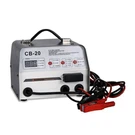




As a supplier of the Spark Design Battery Charger, I've witnessed firsthand the diverse needs and unique characteristics of different battery types when it comes to charging. Understanding the charging time differences between various battery types is crucial for consumers, whether they're using our Spark Design Battery Charger for personal electronics, vehicles, or industrial applications. In this blog, we'll explore these differences in detail, helping you make informed decisions about your charging needs.
The Basics of Battery Charging
Before delving into the charging time differences, it's essential to understand the basic principles of battery charging. The charging process involves the movement of electrical energy from the charger to the battery, where it is stored as chemical energy. The rate at which this energy transfer occurs depends on several factors, including the battery's chemistry, capacity, and the charger's output power.
The charger's output power is measured in amperes (A) or watts (W). A higher output power generally means a faster charging time, but it's important to match the charger's output to the battery's requirements to avoid overcharging, which can damage the battery and reduce its lifespan.
Common Battery Types and Their Charging Characteristics
Let's take a closer look at some of the most common battery types and how they interact with our Spark Design Battery Charger.
Lead - Acid Batteries
Lead - acid batteries are widely used in automotive, marine, and backup power systems. They are known for their relatively low cost and high surge current capabilities. However, they have a slower charging rate compared to some other battery types.
The charging time of a lead - acid battery depends on its state of charge, capacity, and the charger's output current. For example, a fully discharged 100 - ampere - hour (Ah) lead - acid battery charged with a 10 - amp charger would theoretically take about 10 hours to reach a full charge. However, in practice, the charging time is longer due to the inefficiencies in the charging process and the need for a final equalization charge to ensure all cells are fully charged.
Our Spark Design Battery Charger is designed to optimize the charging process for lead - acid batteries. It uses a multi - stage charging algorithm that starts with a high - current bulk charge to quickly replenish most of the battery's capacity, followed by a lower - current absorption charge to top off the battery and a float charge to maintain the battery's charge without overcharging.
Lithium - Ion Batteries
Lithium - ion batteries are popular in portable electronics, electric vehicles, and renewable energy storage systems due to their high energy density, long lifespan, and low self - discharge rate. They can generally be charged faster than lead - acid batteries.
The charging time of a lithium - ion battery is influenced by its capacity, the charger's output current, and the battery's maximum charging current rating. Most lithium - ion batteries can accept a relatively high charging current, allowing for rapid charging. For instance, a 5000 - milliampere - hour (mAh) lithium - ion battery in a smartphone can be charged from 0 to 80% in about an hour using a fast charger.
Our charger is compatible with lithium - ion batteries and is designed to provide a safe and efficient charging process. It monitors the battery's voltage and temperature during charging to prevent overcharging and overheating, which can be dangerous for lithium - ion batteries.
Nickel - Metal Hydride (NiMH) Batteries
NiMH batteries are commonly used in rechargeable consumer electronics, such as digital cameras and cordless phones. They offer a good balance between energy density and cost.
The charging time of NiMH batteries is typically longer than that of lithium - ion batteries but shorter than lead - acid batteries. A standard NiMH battery charger usually charges at a relatively low current to prevent overheating and damage to the battery. For example, a 2500 - mAh NiMH battery might take about 3 - 4 hours to charge using a 1 - amp charger.
Our Multifunctional Charger with Charging State can be used to charge NiMH batteries effectively. It provides a controlled charging current and has built - in safety features to protect the battery during the charging process.


Nickel - Cadmium (NiCd) Batteries
NiCd batteries were once very popular in portable electronics but have been largely replaced by NiMH and lithium - ion batteries due to environmental concerns related to cadmium. However, they are still used in some industrial applications.
NiCd batteries can be charged relatively quickly, but they are prone to the "memory effect," which can reduce their capacity if they are not fully discharged before recharging. The charging time of a NiCd battery depends on its capacity and the charger's output current.
Our charger can also charge NiCd batteries, and it helps to minimize the memory effect by providing a proper charging cycle.
Factors Affecting Charging Time
In addition to the battery type, several other factors can affect the charging time when using our Spark Design Battery Charger.
Battery Capacity
The larger the battery's capacity, the longer it will take to charge. A 100 - Ah battery will take longer to charge than a 50 - Ah battery, assuming the same charger output current.
Charger Output Power
A charger with a higher output power can charge a battery faster. For example, a 20 - amp charger will charge a battery faster than a 10 - amp charger, all other factors being equal.
Battery State of Charge
A battery that is more deeply discharged will take longer to charge than a battery that is only partially discharged. Our charger adjusts its charging algorithm based on the battery's state of charge to optimize the charging time.
Environmental Temperature
The charging time can also be affected by the environmental temperature. Batteries charge more slowly in cold temperatures and may require a higher charging current to maintain the charging rate. In hot temperatures, overheating can be a concern, and the charger may need to reduce the charging current to protect the battery.
The Advantage of Our Spark Design Battery Charger
Our Spark Design Battery Charger offers several advantages when it comes to charging different battery types.
Versatility
It is compatible with a wide range of battery types, including lead - acid, lithium - ion, NiMH, and NiCd batteries. This means that you can use a single charger for all your battery charging needs, whether you're charging your car battery, smartphone battery, or camera battery.
Safety
Safety is our top priority. Our charger is equipped with multiple safety features, such as overcharge protection, overcurrent protection, and short - circuit protection. These features ensure that your batteries are charged safely and that your charger and devices are protected from damage.
Efficiency
Our charger uses advanced charging algorithms to optimize the charging process for each battery type. This results in faster charging times and a longer battery lifespan. For example, the multi - stage charging algorithm for lead - acid batteries helps to reduce the overall charging time while ensuring a full and healthy charge.
Portability
We also offer a Portable Charger with Handle, which is convenient for on - the - go charging. Whether you're traveling, camping, or working in the field, you can easily take our charger with you and keep your batteries charged.
Conclusion
Understanding the charging time differences between different battery types is essential for choosing the right charger and ensuring the optimal performance and lifespan of your batteries. Our Spark Design Battery Charger is designed to meet the diverse charging needs of various battery types, offering a safe, efficient, and versatile charging solution.
If you're interested in learning more about our products or have specific charging requirements, we invite you to contact us for a detailed discussion. Our team of experts is ready to assist you in finding the best charging solution for your needs. Whether you're a consumer looking for a reliable charger for your personal devices or a business in need of industrial - grade charging solutions, we have the products and expertise to meet your requirements.
References
- Linden, D., & Reddy, T. B. (2002). Handbook of Batteries. McGraw - Hill.
- Burrows, L. (2018). Battery Charging Technologies. Newnes.
- Tarascon, J. M., & Armand, M. (2001). Issues and challenges facing rechargeable lithium batteries. Nature, 414(6861), 359 - 367.