



Do MIG MAG welding machines produce a lot of spatter? This is a question that often comes up among welders and those in the metalworking industry. As a supplier of MIG MAG welding machines, I've had the opportunity to see firsthand how these machines perform in various situations and understand the factors that contribute to spatter. In this blog post, I'll delve into the topic, exploring the causes of spatter in MIG MAG welding, ways to reduce it, and how our products can help you achieve a cleaner weld.
Understanding Spatter in MIG MAG Welding
Spatter refers to the small droplets of molten metal that are ejected from the weld pool during the welding process. It's a common issue in MIG (Metal Inert Gas) and MAG (Metal Active Gas) welding, and while it may seem like a minor annoyance, it can have significant implications for the quality of the weld and the efficiency of the welding operation.
When spatter occurs, it can adhere to the workpiece, the welding gun, and surrounding equipment. This not only makes the post - welding cleanup process more time - consuming but can also affect the appearance of the final weld. In some cases, excessive spatter can even lead to porosity in the weld, which weakens the joint and reduces its overall integrity.
Causes of Spatter in MIG MAG Welding
There are several factors that can contribute to spatter in MIG MAG welding. One of the primary causes is incorrect welding parameters. For example, if the voltage is set too high, the arc becomes unstable, causing the molten metal to be ejected from the weld pool. On the other hand, if the wire feed speed is too fast or too slow relative to the voltage, it can also lead to spatter.
The type of shielding gas used is another important factor. In MAG welding, the active gases can react with the molten metal in different ways. If the gas composition is not properly adjusted for the type of metal being welded, it can cause excessive spatter. For instance, using a gas with too high a percentage of oxygen or carbon dioxide can increase the likelihood of spatter formation.
The quality of the welding wire also plays a crucial role. Impurities in the wire can cause inconsistent melting and lead to spatter. Additionally, the diameter of the wire and its feed rate need to be carefully matched to the welding conditions. A wire that is too thick or thin for the application can result in spatter.
Reducing Spatter in MIG MAG Welding
Fortunately, there are several strategies that can be employed to reduce spatter in MIG MAG welding. Firstly, ensuring that the welding parameters are correctly set is essential. This requires a good understanding of the metal being welded, the type of shielding gas, and the welding machine's capabilities. Welders should consult the machine's manual and conduct test welds to find the optimal settings for each job.
Using high - quality welding consumables can also make a significant difference. MIG Flux Wire is designed to minimize spatter and improve the quality of the weld. These wires often have a flux core that helps to stabilize the arc and reduce the formation of spatter.

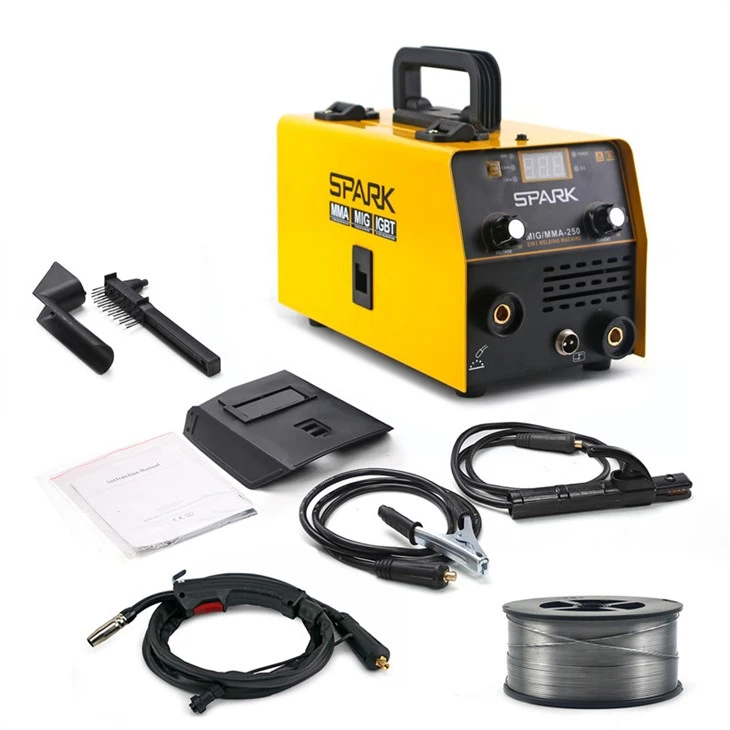
Proper maintenance of the welding equipment is also crucial. Regularly cleaning the welding gun, checking the wire feed system for any blockages or misalignments, and ensuring that the contact tip is in good condition can all help to reduce spatter.
Our MIG MAG Welding Machines and Spatter Reduction
At our company, we understand the importance of minimizing spatter in MIG MAG welding. That's why our Three PCB IGBT MIG Welding Machine and Three PCB 15kg Wire MIG Welding Machine are designed with advanced features to help reduce spatter.
Our machines are equipped with precise control systems that allow for accurate adjustment of welding parameters. This means that welders can easily fine - tune the voltage, wire feed speed, and other settings to achieve a stable arc and minimize spatter. The IGBT technology used in our machines provides better power control and efficiency, resulting in cleaner welds.
In addition, our machines are compatible with a wide range of high - quality welding wires, including the MIG Flux Wire. This gives welders the flexibility to choose the right consumables for their specific applications and further reduce spatter.
Conclusion
While MIG MAG welding machines can produce spatter, it is not an inevitable problem. By understanding the causes of spatter and implementing appropriate strategies to reduce it, welders can achieve high - quality, spatter - free welds. Our MIG MAG welding machines are designed to help you overcome the challenges of spatter and improve the efficiency and quality of your welding operations.
If you're interested in learning more about our MIG MAG welding machines or have any questions regarding spatter reduction in welding, we encourage you to contact us. Our team of experts is ready to assist you in finding the right solution for your welding needs. Whether you're a small - scale workshop or a large industrial operation, we have the products and knowledge to help you succeed.
References
- Welding Handbook, American Welding Society
- Principles of Metal Arc Welding, Various Industry Publications