

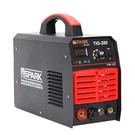
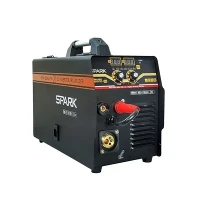


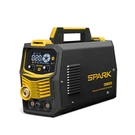

MIG (Metal Inert Gas) and MAG (Metal Active Gas) welding are two of the most widely used welding processes in the industry, offering high efficiency, good weld quality, and versatility. As a leading supplier of MIG MAG welding machines, we often receive inquiries about the maximum welding thickness these machines can handle. In this blog post, we will delve into the factors that influence the maximum welding thickness of MIG MAG welding machines and provide some insights to help you make the right choice for your welding needs.
Understanding MIG and MAG Welding
Before we discuss the maximum welding thickness, it's important to understand the basic principles of MIG and MAG welding. In MIG welding, an inert gas such as argon or helium is used to shield the weld pool from the atmosphere, preventing oxidation and other contaminants. This process is commonly used for welding non - ferrous metals like aluminum. MAG welding, on the other hand, uses an active gas mixture, typically a combination of carbon dioxide and argon. The active gas helps to improve the arc stability and penetration, making it suitable for welding ferrous metals such as steel.


Factors Affecting the Maximum Welding Thickness
Several factors play a crucial role in determining the maximum welding thickness that a MIG MAG welding machine can achieve.
Power Output
The power output of a welding machine is one of the most important factors. Higher power output generally means that the machine can provide more energy to melt the base metal, allowing for thicker materials to be welded. Our Multifunction MIG Welding Machine offers a wide range of power settings, which gives you the flexibility to weld different thicknesses of materials. A machine with a higher amperage rating can generate a more intense heat, enabling deeper penetration and welding of thicker workpieces. For example, a welding machine with a rated output of 200 amps can typically weld thicker materials compared to a 130 - amp machine.
Wire Diameter and Feed Rate
The diameter of the welding wire used also affects the welding thickness. Thicker wires can transfer more filler metal into the weld joint, which is necessary for welding thicker materials. However, using a too - thick wire may require a higher power output from the welding machine to ensure proper melting. Additionally, the wire feed rate needs to be adjusted according to the wire diameter and the welding speed. A higher wire feed rate can increase the deposition rate of the filler metal, which is beneficial for welding thicker materials. Our Single PCB MIG Welding Machine with Compact Torch is designed to support different wire diameters and has a precise wire feed control system, allowing you to optimize the welding process for various thicknesses.
Gas Selection
The type of shielding gas used in MIG and MAG welding can impact the welding performance and the maximum achievable thickness. In MAG welding, a gas mixture with a higher percentage of carbon dioxide can increase the arc penetration, which is helpful for welding thicker steel plates. In MIG welding of non - ferrous metals, the choice of inert gas can also affect the heat transfer and weld quality. For example, pure argon is commonly used for aluminum welding, but a mixture of argon and helium can provide better heat input for thicker aluminum sections.
Welding Technique
The welding technique employed by the operator is another significant factor. Proper welding speed, electrode angle, and bead overlap can all contribute to achieving satisfactory welds in thick materials. For thick - section welding, multi - pass welding is often required. In multi - pass welding, each pass helps to build up the weld joint gradually, ensuring proper fusion and strength. An experienced welder can adjust the welding parameters and technique according to the material thickness and the specific requirements of the welding job.
General Guidelines for Maximum Welding Thickness
While it's difficult to provide an exact maximum welding thickness for all MIG MAG welding machines, we can offer some general guidelines based on the power output of the machine.
Low - Power Machines (Up to 130 Amps)
These machines are typically suitable for light - duty welding applications. They can usually handle materials with a thickness of up to 3 - 4 mm. They are often used for small - scale fabrication, DIY projects, and repairs. Our Family Use Popular Transformer MIG Welding Machine in the lower - power range is ideal for such applications, providing a cost - effective solution for home users and hobbyists.
Medium - Power Machines (130 - 200 Amps)
Medium - power MIG MAG welding machines can weld materials with a thickness ranging from 4 - 10 mm. These machines are commonly used in general fabrication shops for welding structural steel, automotive components, and machinery parts. They offer a good balance between power and portability, making them a popular choice for many welding professionals.
High - Power Machines (Over 200 Amps)
High - power machines are designed for heavy - duty welding applications. They can handle materials with a thickness of 10 mm or more, and in some cases, even up to several centimeters. These machines are often used in industries such as shipbuilding, heavy equipment manufacturing, and construction. However, they usually require a three - phase power supply and are less portable compared to lower - power machines.
Choosing the Right Machine for Your Needs
When selecting a MIG MAG welding machine based on the maximum welding thickness, it's important to consider not only the current thickness of the materials you are working with but also any potential future projects. If you expect to work with thicker materials in the future, it may be wise to invest in a machine with a higher power output. Additionally, consider the type of materials you will be welding, as different metals may require different welding parameters and gas mixtures.
As a professional MIG MAG welding machine supplier, we understand that each customer has unique welding requirements. Our team of experts is always available to provide you with personalized advice and help you choose the right machine for your specific needs. Whether you are a small - scale workshop or a large - scale industrial enterprise, we have a wide range of products to meet your demands.
If you are interested in purchasing a MIG MAG welding machine or have any questions about our products, we encourage you to contact us for a detailed discussion. Our sales representatives will be glad to assist you with product information, pricing, and technical support. We are committed to providing high - quality welding machines and excellent customer service to ensure your welding projects are a success.
References
- AWS Welding Handbook, Volume 1: Fundamentals of Welding, American Welding Society.
- Welding Processes and Practices, W. J. Samuels.
- Miller Electric Mfg. Co. Technical Publications on MIG and MAG Welding.